

Green Jobs Blog Series: Green Skills
Installment #2
By Catherine Jett, Research Strategist | August 2026Ask someone what a “green job” requires, and they'll probably guess technical, specialized skills—solar panel installation, environmental compliance, and the like. But the data tell a different story. For jobs tied to Minnesota's clean electricity goal, the most in-demand skills are communication, operations, and problem-solving—the same skills that show up everywhere else in the labor market. In the first post in this series, my colleague Bryan Lindsley explained why Stratasight is anchoring our Green Jobs Talent Supply and Demand Report in the 2040 clean electricity goal. While all four of the state’s clean energy goals matter, clean electricity 2040 is the most tractable one to build occupational analysis and near-term workforce strategy around. At the same time, increasing green skills prevalence in Minnesota's workforce is foundational to achieving the state's other clean energy goals. This post picks up these threads, using Lightcast's global green skills taxonomy to see what skills actually show up in job postings tied to clean electricity, and how they compare to the broader landscape of green skills across Minnesota's economy.
Top requested green skill types
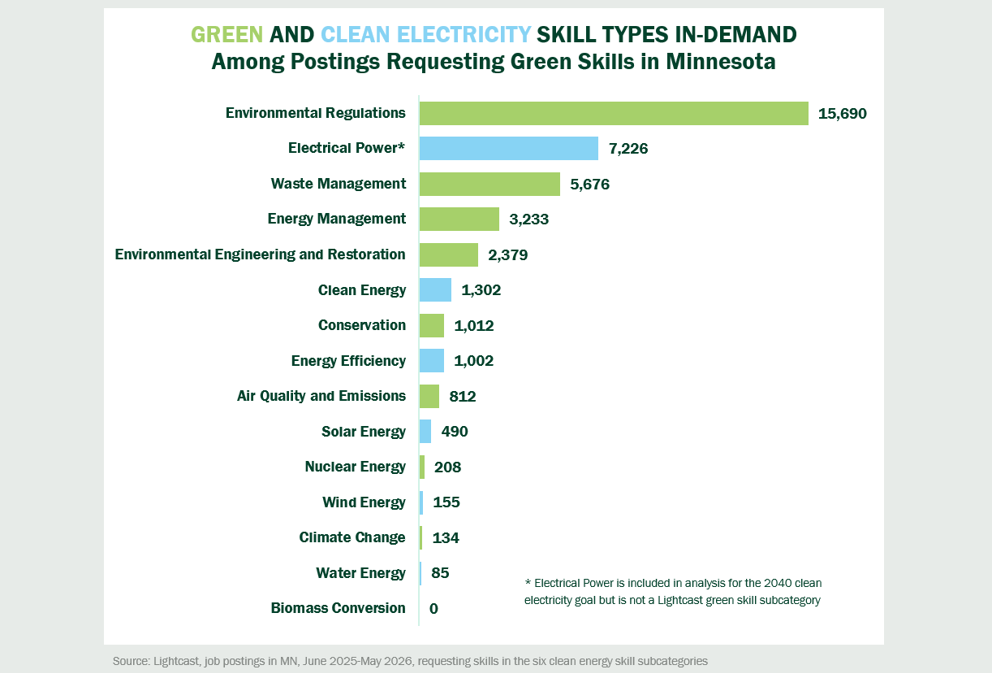
Among all green skills and clean electricity skills, Environmental Regulation skills are the most in-demand in Minnesota, appearing in over 15K job postings in the past year. Electrical Power, relevant to clean electricity, is the second most in-demand set of skills, with over 7K job posts. Other skills related to the state’s clean electricity goal appear in far fewer posts: About 1,300 posts request Clean Electricity, about 1,000 Energy Efficiency, just under 500 Solar Energy, and fewer for Wind and Water Energy.
As of its 2026 update, Lightcast’s taxonomy includes 1,623 individual green skills across 14 categories. Homing in on our state’s clean electricity 2040 goal, Stratasight is focusing on six subcategories most relevant to carbon-free electricity: clean energy, electrical power, energy efficiency, solar energy, water energy, and wind energy. (One of these, electrical power, is not considered a green skill subcategory by Lightcast, but includes skills that will be critical for meeting Minnesota’s clean electricity goal.)
Clean Electricity Careers Skills
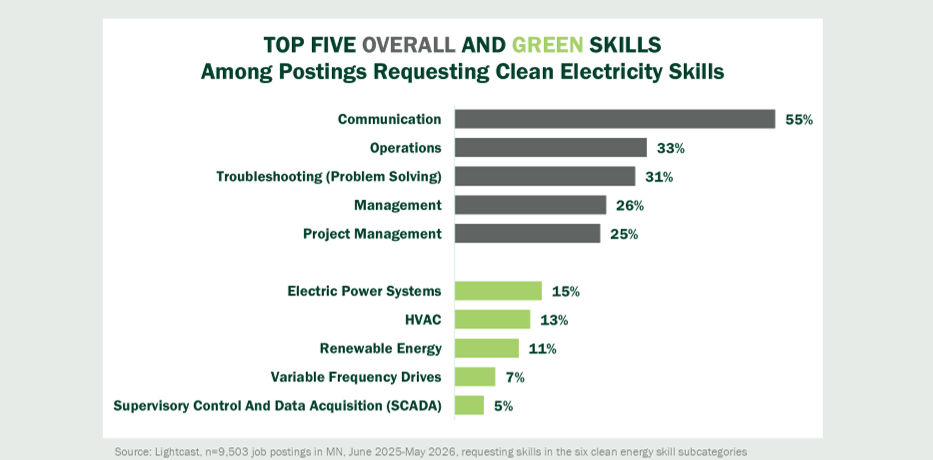
Every job uses a variety of skills, some deeply specialized and others widely applicable to many careers. Zeroing in on the jobs needed to meet Minnesota’s 2040 clean electricity goal, the specific skills most commonly requested aren't necessarily green ones. For job posts requesting clean electricity skills, the most in-demand skills are broadly applicable, serving jobseekers across roles and industries: communication, operations, troubleshooting, management, and project management.
Green skills do not appear at the top of the list; the most in-demand green skill among these jobs is Electric Power Systems, at 15th. The other top five most-requested green skills, in order, are HVAC, Renewable Energy, Variable Frequency Drives, and Supervisory Control and Data Acquisition (SCADA).
Transferrable skills
Skills transferability is a genuine strategic advantage for how Minnesota builds and sustains its clean energy workforce. Given that 88% of core Energy and Natural Resources (ENR CTE cluster) occupations are shared with other career clusters, the workforce needed for our clean energy transition is likely to be found across our state’s industries—good news for sourcing talent. Similarly, as we have just seen in Clean Electricity Careers, many skills needed for success in clean energy jobs transfer readily to other sectors, important for building a resilient workforce as the economy and technology evolve.
Among Energy and Natural Resources Occupations
That transferability holds up even when you zoom in: within the ENR cluster itself, the same skills show up again and again across sub-clusters. Across all ENR sub-clusters, employer-posted job requirements consistently call for the same essential and technical skills:
Essential (durable) skills:Communication, Collaboration, Analysis, Leadership, Planning
Technical knowledge and skills: Operations & Scheduling, Project Management, Electronics/Electrical Systems, Preventive Maintenance, Turbines/Power Plants, Environmental Science
Among Advanced Manufacturing Jobs
This pattern isn't unique to the energy sector; it extends into advanced manufacturing, a sector critical to Minnesota's clean tech supply chain. Stratasight analyzed skills transferability across advanced manufacturing jobs in March 2026 on behalf of the Minnesota Sustainable Plastics Innovation Regional Engine (M-SPIRE) initiative at the University of Minnesota. The analysis included job postings for advanced manufacturing as a whole and within each of four subsectors: clean tech (i.e., clean fuel production), med tech, sustainable plastics manufacturing, and semiconductor/microelectronics production.
Two things stand out: skills are highly transferable across advanced manufacturing subsectors, and they closely mirror what we see in ENR and clean electricity careers postings, discussed above. Considering all occupations and education levels, the top in-demand skill is the same across every subsector: communication—a foundational skill valued well beyond advanced manufacturing. Four other skills appear the top ten across all subsectors: leadership, operations, management, and problem solving.
Clean Tech Careers at Different Education Levels
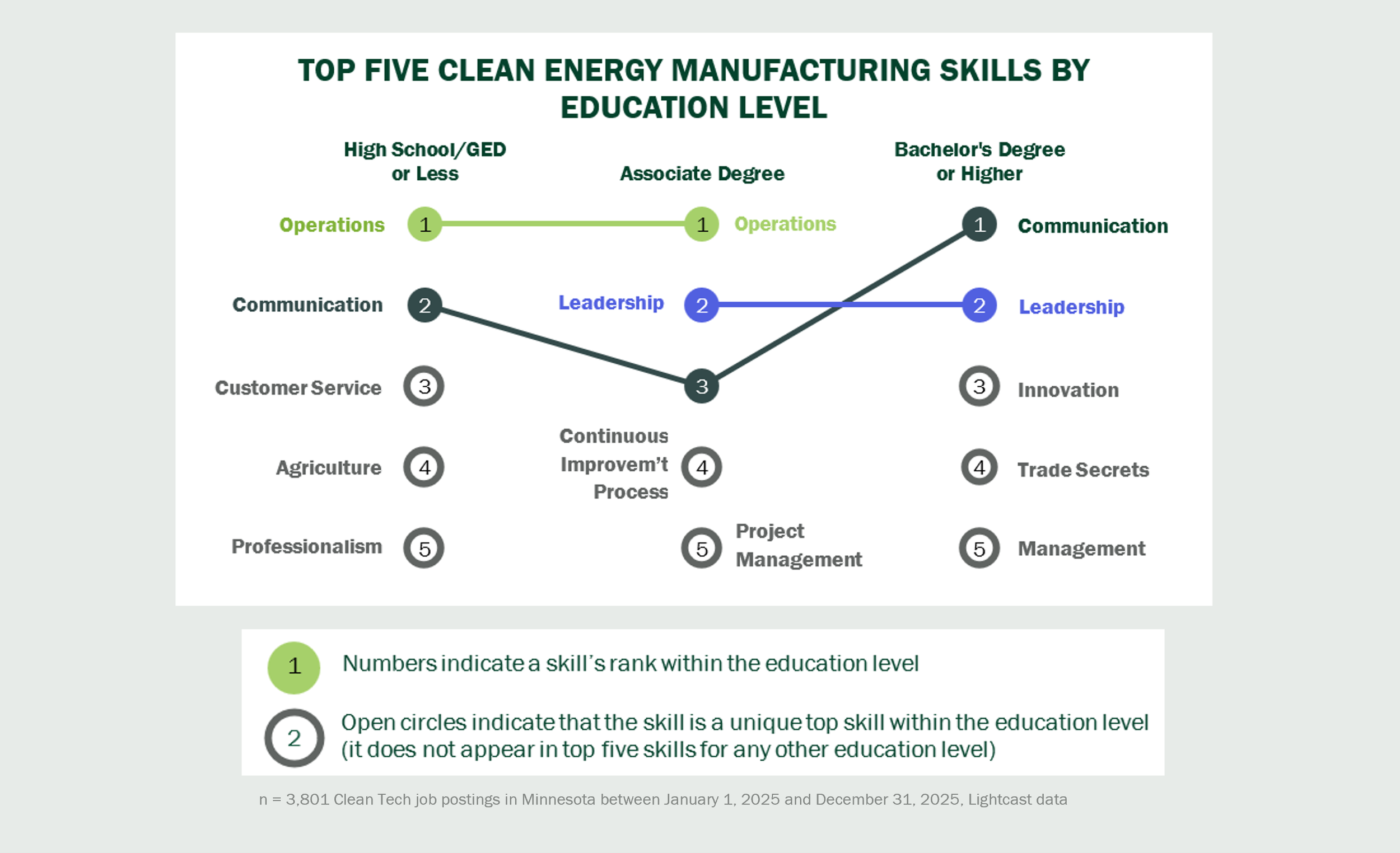
Clean energy manufacturing jobs span every level of education, and the skills employers ask for shift depending on that level. Three of the most transferrable skills identified above—operations, communication, and leadership—show up consistently across education levels. Yet, when zooming in on the top five skills at each education level, around half of the skills at each level are unique. Clean tech jobs requiring no more than a high school education are more likely to call for skills in customer service, agriculture, and professionalism. Jobs requiring an associate degree lean toward continuous improvement process and project management. Jobs requiring a bachelor’s degree or higher ask for skills in innovation, trade secrets, and management.
Key takeaways
Across every lens in this analysis—top requested skills, transferability, and education level—the same pattern holds: Minnesota's clean electricity workforce will require critical skillsets already woven into the talent profile of workers in a wide range of industries. The skills most in demand for clean electricity jobs are largely the same ones that show up across energy and natural resources, advanced manufacturing, and at every education level. The green skills that do stand out—Electric Power Systems and Environmental Regulation—layer on top of that shared foundation rather than replace it. For workforce strategy, this means the path to 100% clean electricity by 2040 may benefit from strengthening workers’ durable, transferable skills as well as building clean-electricity-specific expertise.
Stratasight's green jobs hub (forthcoming September 2026) will make this data explorable in real time, giving employers, educators, and workforce boards a way to see current demand for the occupations and skillsets that matter most to Minnesota's clean energy transition by region. Stratasight’s green jobs demand analysis (forthcoming December 2026) will take this a step further, detailing specific workforce needs to achieve carbon-free electricity by 2040.
About Stratasight Research and Consulting
Stratasight supports Minnesota in building a more aligned, opportunity-rich labor economy. Through rigorous research and analysis—from market dynamics to talent gaps and needs—we consult with leaders to solve our region’s biggest economic, workforce, and talent challenges. Born from RealTime Talent’s decade-long legacy of trusted analysis and collaborative leadership, Stratasight sits at the intersection of Minnesota’s workforce ecosystem, uniquely bridging policy, education, industry, and employer—translating complexity into clarity and clarity into action.
This blog series is supported by a grant from the McKnight Foundation as part of Stratasight’s Advancing Minnesota’s Green Workforce initiative.
Minnesota’s Advanced Manufacturing Workforce: Research Findings and Strategic Insights
Minnesota's advanced manufacturing sector is changing rapidly, creating new workforce challenges and opportunities across medical technology, semiconductors, sustainable plastics, and clean technology. The strategic insights below translate Stratasight's research for the Minnesota Sustainable Plastics Innovation Regional Engine (M-SPIRE) into practical implications for employers, educators, industry associations, and policymakers.
Manufacturing Needs More Than Engineers and Production Workers
What We FoundEngineering and production occupations play critical roles in advanced manufacturing, but they represent only part of the industry’s workforce. The M-SPIRE Advanced Manufacturing Skills Analysis found demand across all major occupational groups, with management occupations being the most commonly advertised type. Demand was also very high for occupations related to architecture and engineering, business and financial operations, production, and computer and mathematical occupations.
Among specific detailed occupations, demand is indeed highest for Industrial Engineers, Other Production Workers, and Mechanical Engineers—but it is nearly as high for Marketing Managers, Other Computer Occupations, and Software Developers. This breadth reflects the range of work required to operate advanced manufacturing businesses. Engineers help design products and improve processes, production workers produce and inspect—but companies also need people in many professions to manage, market, support, and deliver products and operations.
Advanced manufacturing offers opportunities across education levels—from positions requiring a high school diploma, GED, or less to roles requiring associate, bachelor’s, and advanced degrees. The research therefore points to multiple pathways into the industry, not only traditional four-year engineering programs.
Why It MattersThe perception that advanced manufacturing careers are primarily for engineers or production workers can unintentionally limit the industry's future workforce. Students may overlook rewarding career opportunities because they assume manufacturing is not aligned with their interests or educational goals.
Expanding awareness of the industry's wide range of career pathways can help employers reach new talent, enable educators to better connect students with opportunities, and strengthen Minnesota's workforce pipeline. A broader understanding of manufacturing careers also helps ensure the industry attracts people with diverse experiences, interests, and talents.
Green Jobs Blog Series:
Are We On Track?
Installment #1
By Bryan Lindsley, Director of Strategic Initiatives | May 2026This first installment in Stratasight’s Green Jobs Blog Series explores one of the most important — and often overlooked — questions shaping Minnesota’s clean energy future: Are we actually building the workforce needed to achieve the state’s ambitious climate and clean energy goals? The article examines the growing ecosystem of organizations, policymakers, educators, employers, and workforce leaders working to answer that question, while also highlighting a critical challenge: different clean energy goals require different workforce strategies, definitions, and talent pipelines. Drawing on current statewide initiatives, labor market data, and emerging workforce planning efforts, the piece outlines why Minnesota’s 100% carbon-free electricity by 2040 goal may offer the clearest and most actionable framework for building an effective clean energy workforce strategy.
The post also provides an inside look at Stratasight’s ongoing work with the McKnight Foundation and the statewide Clean Energy Workforce Table to develop a forthcoming Green Jobs Talent Supply and Demand Report. It discusses the methodological and strategic questions involved in forecasting future workforce demand, identifying occupational gaps, mapping transferable skills, and aligning education and training systems to Minnesota’s evolving clean energy economy. Ultimately, the article argues that data-driven workforce planning — grounded in clear goals, shared definitions, and cross-sector collaboration — will be essential if Minnesota hopes to meet its climate commitments while building a strong, inclusive, and future-ready workforce.